
The gold behind listening and how to become better at it
 Lisa Gill
19 March 2026
Lisa Gill
19 March 2026
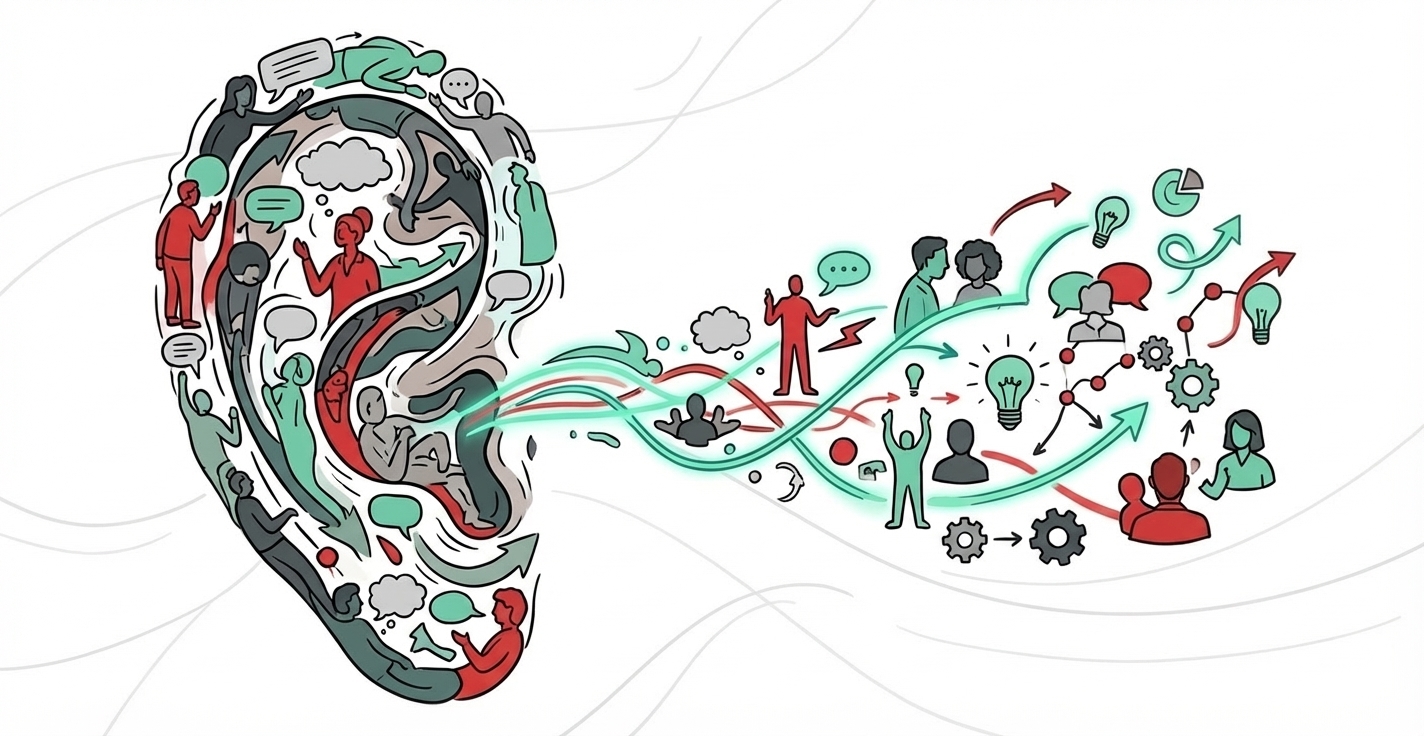
Recently I had the pleasure of meeting a group of CEOs from progressive organisations in Tokyo. At the end of our discussion, one of them turned to me and said: “It sounds like listening is a core ability needed to lead in this new paradigm. What is your advice on how to become a better listener?” I told her I wanted to jump for joy because I really believe if more people asked this question, the world would be a much better place!
As my colleague Karin likes to say, “If people truly knew the gold behind listening, there would be a listening gym on every corner.” Listening is often thought of as being a somewhat fluffy skill – nice to have but not essential.
But when we really listen, it contributes to:
Psychological safety – people feel safe when they feel heard, seen and taken seriously
Innovation – taking in divergent perspectives but also new ideas and solutions emerge from the listening field
Transforming conflicts – it builds trust and restores relationships when we feel our needs and values are heard, even if we disagree
Quality decisions – people are able to converge on a decision when they feel heard, even if it's not their preference, and we can also improve decisions (and commitment to them) if we integrate objections or suggestions
Robust relationships and collaboration – listening to each other (especially when we differ in terms of communication or working styles) builds trust and openness, two keys to effective and sustainable collaboration
Motivation and commitment – people are much more willing to find their intrinsic motivation and take mental ownership when they feel heard in how they feel about something
Effective leadership – the best leaders are those who can listen so people feel heard, but also listen for what's needed or missing for a team, for example, to move forward. (Note: a totally different ability than thinking about what's needed for a team to move forward!)
So, how can we get better at listening? Well, it’s really a lifelong journey of learning, unlearning and getting back to our core human essence. But here are some starting points based on what we at Tuff have learned over the last twenty years of training people in upgrading their listening abilities.
Step 1: Anchor to a compelling purpose
Developing a new ability takes commitment and consistency, even when you don’t feel like doing something or you get busy with your day-to-day activities. That’s why it helps to anchor to an outcome or a result that’s meaningful to you. Which of the bullet points I listed above are most inspiring to you? What could it give you, your relationships, or your team if you became a better listener? Allow yourself to get really excited by the possibilities. Maybe even describe a scene, like a movie, of what becomes possible when you are a listening master!
Step 2: Be a beginner
A crucial step to becoming a better listener is to first acknowledge that you don’t listen at all. In other words, if I already think I’m a good listener, it will seriously limit my ability to improve. To get better at anything, it always helps to have a beginner’s mind. To be humble.
But more confronting than that is the notion that we all tend to overestimate our abilities as a listener. It’s painful when we are confronted with someone – usually a loved one – telling us we aren’t listening. We often defend or argue: “Of course I’m listening!” None of us wants to consider that we have been going around our whole lives partially listening (or not listening at all!). We can have a little self-compassion, though. After all, we aren’t taught listening skills at school or in workplaces.
If you are convinced you’re a great listener already, I invite you to ask a few people around you – colleagues, loved ones – to rate you out of five on your listening skills, where five would be “Wow, I have never felt so heard and so ‘felt’ in all my life!”. Ask them to be brutally honest and if you don’t get a 5/5 rating (which is probable!), ask what was missing or needed for it to be a five. I guarantee you will start to get a truer picture of your listening capacity.
Step 3: Practise, practise, practise
I’ve been with my partner, Shaun, for ten years and early on in our relationship, I gave him some sensitive feedback. “Do you know that you don’t listen sometimes? When I share something, you often wait for your turn to say your thing without acknowledging me or my contribution at all. It makes me feel a little unseen.” He was shocked. Having studied psychology, he had always prided himself on his listening skills and it hurt him to know that I was feeling this way.
Fast forward a few months to when Shaun and I were having a conversation. I was telling him about how my day went and the things that had been challenging, and he was listening. After a few minutes, I paused. “Something feels different in this conversation,” I said. He smiled. “Yeah? Do you notice something?”
It turns out, he’d been taking an online Masterclass with Chris Voss, a former FBI negotiator, and had been practising some of the listening abilities he suggested. Shaun’s upgraded listening has transformed our relationship. Of course, he’s not perfect. It’s still hard for him to listen if I have a complaint about him! But it’s been a profound shift.
I’ll share a few listening techniques you can try but first a caveat. When you start testing these out, it will not feel natural. Like with my partner, at first it feels a little clunky. But I promise, the person on the receiving end will mostly feel grateful that you’re making an effort to listen (if your intention is genuine). Like any new language you learn to speak, you will feel a little silly at first. Persevere, and know that it doesn’t sound as weird to you as it does to them.
Listening tools to try out:
Labelling – add a label to what you hear the person say or what you pick up they’re feeling using “sounds like” or “seems like”. For example, “Sounds like the most difficult/important part of this for you is…” or “Seems like you feel really disappointed…”
Mirroring – simply mirror back some key words of what the person said. You can do this even with just one to three key words they said (especially the most charged words), followed by what Chris Voss calls a dynamic pause. This invites the other person to confirm or disconfirm, and share more.
For example: “You feel lost?.........” or “Misunderstood?........”
Note: I once did this in a training with a manager practising a team meeting. I got him to play a game where whatever his colleagues said, he could only reply by choosing one to three key words plus a dynamic pause. He squirmed and found it so uncomfortable, but after a few minutes, he got the hang of the game. “This feels stupid!” he said. But the team assured him it was actually working! They felt heard, and somehow it was moving things along by him doing very little.Silence – we human beings are so often in a rush. When we slow down and allow moments of silence, it creates presence and allows people to draw on more of what they feel and think. Many of us are accustomed to filling silences so a great practice is to pause for at least ten seconds after someone has spoken before you speak. Very often, they’ll start to add more and go deeper without you saying a word!
Questions – practise asking curious questions, especially when someone says something charged or you sense there is more beneath the surface. For example, “Say more about that…” or “Can you share more about what you mean by X?”
Turn up the volume of what you hear – it seems counterintuitive, but when we mirror back cautiously what someone says (“Sounds like you’re quite frustrated”), it can create the opposite effect of feeling heard. But when we say: “Sounds like you’re extremely frustrated! Like, how can they have made this decision?!” it actually captures something closer to what the other person is feeling. So try exaggerating, or turning up the volume of what you’re hearing. If you go too far, it’s OK – they’ll let you know, and then share more about how it actually is.
Step 4: Cultivate a listening way of being
As you start to practise, even if you start to use the techniques I listed above, you will bump into obstacles. You’ll notice where you feel resistant to listen, or you forget to listen entirely, even though you started out with an intention to. This is good!
To be a great listener, it’s not just about what we do, it’s about how we are. And to cultivate a listening way of being, we need to uncover the unhelpful mindsets that get in the way for us to listen.
Common unhelpful mindsets that are in the way for us to listen are:
“If I listen, they’ll think I agree!”
“If they’re in a negative place, I need to help them find something positive”
“If I listen to them, it might get worse – they might explode!”
“We need to get to a solution or a conclusion fast!”
“If I listen, I’ll have to do something with what they say”
“I don’t like talking about feelings”
“If I listen, I’ll lose control”
“I need to be right”
“If I listen, they’ll expect me to change”
“I need to get this conversation back on track”
“I have to get them to do X, Y or Z…”
Which ones do you recognise the most? (One participant in a course once declared: “I got bingo! I have all of them!”)
Once we can identify our main unhelpful mindsets, we can start to catch ourselves when we end up there. What triggers my unhelpful mindset? And what could I choose instead? I can start to anchor myself to certain habits that help me to get out of a reactive way of being (which is an obstacle for listening) and instead into a conscious, more mindful way of being.
For example:
Someone starts to disagree with me
I stop listening and start to want to argue
I catch myself thinking “I need to prove them wrong” and I notice my jaw is clenched
I take a deep breath and pause for a few seconds
I choose instead to ask a question: “Can you share more about what’s important to you about X?”
As I listen to them, I remind myself that my goal is to listen so they feel heard (and not to be right!)
I label the words and feelings that I picked up
About the learning cycle
In the beginning, practising listening will be a mixed bag. You’ll have some instances where it goes really well and you experience the joy and wonder of someone feeling truly heard and what that makes possible. And then you’ll go into another conversation or meeting and be a terrible listener. All your techniques and good intentions will go out the window. You’ll perhaps want to beat yourself up or give up. But this is part of the learning process.
My colleague Carl Erik likes to say that mastery is being able to be in the gap between how it is, and how you’d like it to be. And with time, as you practise more and more, you’ll start to integrate your listening ability. It will come more easily to you. You start to become someone who can bring a ‘listening being’ to anything they choose. And you’re still human, so you’ll be a terrible listener all of a sudden when you have an argument with your teenager or your partner! The key is to keep practising.
Want to practise listening skills and the other abilities that make a great leader and collaborator?
Consider signing up for our flagship training programme about how to unleash leadership in others.
Some resources for going deeper into listening
The Enemies Project – I’m obsessed with this YouTube channel at the moment where the host facilitates deep listening conversations between two people with completely opposite worldviews.
The Forest of Thought podcast and The Subtle Art of Listening – a lovely podcast conversation in a forest between host Ingrid M. Rieser and Keri Facer, Professor of Educational and Social Futures at the University of Bristol, and co-founder of the Society for Transformative Conversations at the Swedish Agricultural University.
Kiku: The Japanese Art of Good Listening – I haven’t read this yet, but it sounds wonderful. The author talks about ‘listening with the energy of fourteen hearts’...
A video demonstrating mirroring and labelling by Chris Voss – I’m not a fan of all of Chris’ work, he uses his techniques mainly for negotiating and I find them a little harsh, even manipulative sometimes! But if you take it with a pinch of salt, his guides on listening techniques can be helpful.
Otto Scharmer on the four levels of listening – a video where Otto describes the four levels of listening, with Generative Listening being the most sacred.